


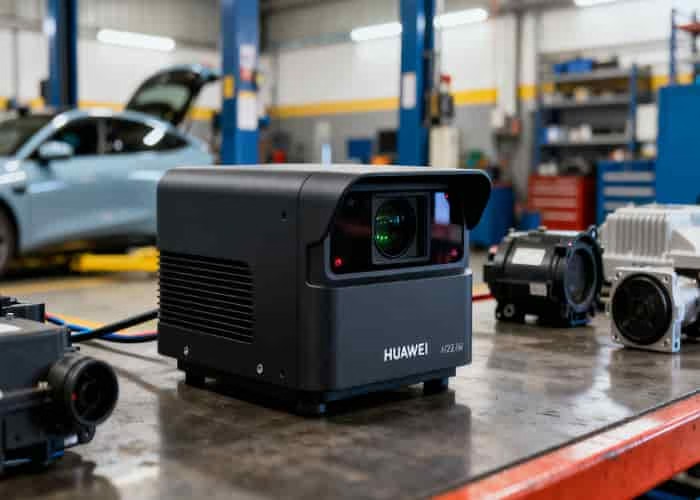
How does Huawei’s 192-line LiDAR perform? As a core perception hardware in autonomous driving, Huawei’s 192-line LiDAR has become the industry benchmark with its exceptional detection capabilities and high-precision resolution. Featuring a vertical 192-line scanning architecture, this LiDAR achieves high-density point cloud acquisition of the surrounding environment.
In terms of detection range, this LiDAR demonstrates formidable long-range perception capabilities. Under typical reflectivity conditions, its effective detection span covers medium-to-long-distance scenarios, granting autonomous driving systems ample decision-making time. Combined with a high-refresh-rate scanning mechanism, it ensures precise tracking of dynamic targets, significantly enhancing the vehicle’s response speed to sudden events.
Environmental adaptability represents another major advantage of Huawei’s 192-line LiDAR. Facing extreme weather conditions such as direct glare, heavy rain, and dense fog, adaptive adjustment technology dynamically optimizes signal transmission intensity and reception sensitivity to effectively penetrate interference factors. This significantly reduces the failure risk of traditional visual sensors under harsh conditions, providing redundant safety assurance for autonomous driving.
From a technical architecture perspective, the laser radar’s integrated design reduces hardware size while lowering power consumption and heat generation, facilitating integration with the vehicle’s forward-facing main radar. Deeply integrated with Huawei’s proprietary human-like decision-making algorithm, the LiDAR data generates real-time road topology, enabling advanced driver assistance functions to operate independently of high-definition maps.
Huawei’s 192-line LiDAR has demonstrated significant value. In sudden scenarios like “ghost jaywalking,” the system rapidly identifies pedestrians or non-motorized vehicles crossing laterally and triggers emergency braking within milliseconds. When encountering irregular obstacles like road construction cones or debris, the system assists in planning obstacle-avoidance paths.
How does Huawei’s 192-line LiDAR perform? These capabilities collectively form a full-stack intelligent driving solution covering urban roads, highways, and parking scenarios, propelling autonomous driving technology toward safer and more reliable stages.






Leave a Reply