


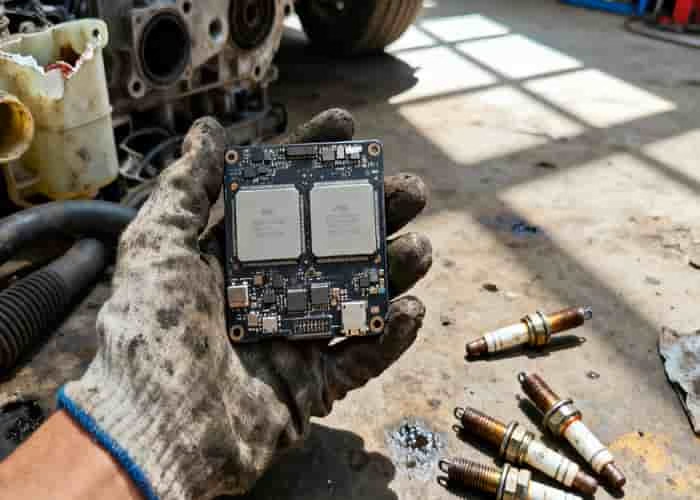
Can Li Auto’s dual-chip architecture truly enhance system fluidity? Indeed, the dual-chip architecture employed by Li Auto’s intelligent cockpit effectively improves system fluidity by leveraging chip specialization and computational redundancy to overcome performance bottlenecks that arise when a single chip handles complex tasks.
Traditional single-chip architectures must simultaneously handle multiple tasks like vehicle control and voice interaction. As screen counts increase and interaction methods evolve, the computational power and bandwidth of a single chip often become bottlenecks, leading to lag or delays. The dual-chip architecture physically isolates tasks, assigning them to different chips—one dedicated to the entertainment system and intelligent interaction.
The redundancy design of the dual-chip architecture provides long-term assurance for system fluidity. As software iterations and feature additions gradually consume a single chip’s computational capacity, the dual-chip architecture reserves computational headroom to support future complex interaction scenarios—such as multi-screen coordination, high-precision 3D modeling, or real-time AI computing.
The dual-chip architecture’s advantage shines in multitasking fluidity. While the driver uses navigation, the front passenger can simultaneously stream HD video or run cloud gaming without interference. Rear passengers can gesture-control the entertainment screen while the system quickly recognizes commands and responds—without delays caused by the driver’s operations.
Does Li Auto’s dual-chip architecture truly enhance smoothness? This architecture represents an inevitable evolution toward higher computing power and integration in smart cockpits. As in-vehicle screen resolutions increase and interaction methods diversify, the physical limitations of single-chip solutions become increasingly apparent. Through modular design, the dual-chip architecture ensures sustained smooth performance over extended use.








Leave a Reply