



Can the Shallow Charge-Shallow Discharge Strategy Truly Extend the Lifespan of Li Auto’s New Generation Ternary Lithium Batteries? Li Auto’s new generation ternary lithium batteries indeed benefit from a shallow charge-shallow discharge strategy, which effectively extends their lifespan. This conclusion stems from the chemical reaction mechanisms inherent in battery materials during charging and discharging processes.
When a battery is fully charged, lithium ions excessively intercalate into the layered structure of the cathode, triggering phase transitions and oxygen evolution reactions that gradually collapse the crystal lattice. During deep discharge, lithium ions become difficult to deintercalate from the graphite surface of the anode, potentially causing electrode pulverization.
The shallow charge-shallow discharge strategy prevents these extreme reactions by maintaining the battery within a specific charge range. Specifically, timely recharging when the battery level is low prevents lithium metal precipitation on the anode. Stopping charging when the battery approaches full capacity reduces structural stress on the cathode material and lowers the rate of side reactions between the electrodes and electrolyte.
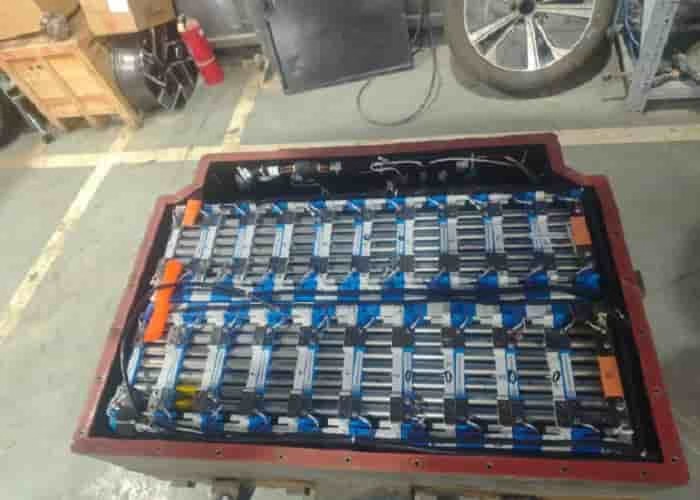
Practical results show that ternary lithium batteries consistently using shallow charge-discharge cycles exhibit significantly better capacity retention than those operating in full charge-discharge cycles. When coordinated with a battery management system, shallow cycles also reduce voltage variations among cells within a pack, ensuring more consistent operational states across all cells.
During charging and discharging in high-temperature environments, the rate of side reactions increases exponentially. Shallow charging mitigates thermal runaway risks by minimizing heat generation. Even in cold conditions, shallow charging prevents lithium dendrite formation on the anode surface by avoiding deep discharges.
Shallow charge-discharge does not entirely prohibit deep cycles. Periodic full charge-discharge cycles help calibrate the BMS’s state-of-charge estimation accuracy, preventing data drift from prolonged shallow charging. However, such calibration cycles need not be frequent—once monthly suffices.
Can the shallow charge-shallow discharge strategy truly extend the lifespan of Li-ion batteries? By scientifically controlling charge/discharge depth, this approach prolongs battery life through material protection, thermal management, voltage balancing, and other mechanisms, providing robust support for the long-term reliable operation of new energy vehicles.









Leave a Reply